Home / Maps / Enceladus station
Enceladus station map: a base under Saturn
A research station on the Saturn-facing side of Enceladus at 54.5° S, built to sample the plumes without anyone going near them. Every module, cable and distance on these maps comes from the same layout file the simulation is built from.
The station
The station fits in 90 by 40 m. A node with the airlock joins the habitation module to the west and the laboratory to the east; a short tunnel runs south to life support, so the service module never touches the living quarters. At the east end, as far from the beds as the row allows, is the sealed bay where plume samples arrive from the drone hangar next door: the laboratory stands between the bay and the habitation module, 18 m apart where the rule asks 12 m. The habitation windows face Saturn to the north and the plume field to the south.
The site
Two things are kept far away. The fission power unit stands 400 m east, its shadow shield turned toward the station, because sunlight at Saturn is too weak to live on. The lander pad is 1,010 m north behind a berm: in gravity this low, ice kicked up by a landing engine flies close to a kilometre. Crews ride between pad and station in a pressurised rover, and the sampling drone leaves south toward the plumes.
Saturn, the plumes and the horizon
Enceladus keeps one face to Saturn, so from the station Saturn stands 35° above the northern horizon and never moves. To the south, the nearest tiger stripe, Baghdad Sulcus, is 77 km away; a plume column above it rises 38° into the southern sky at its 100 km level, with its base hidden by the curve of the moon.
Close to the station the curve is just as strong. From the habitation window the horizon is only 1,145 m away, and the pad 1,010 m out sits just inside it.
What is drawn
- Pressurised, crewed module
- Life support and power (service)
- Unpressurised: hangar, antenna, pad
- Sealed sample bay (biocontainment)
- Reactor
- Power cable
- Antenna feed (data)
- Sealed sample transfer
- Rover route from the pad
- Drone corridor
- Lander pad keep-out
- Reactor standoff
- The shield's full shadow
- Horizon from the windows
- Window field
- View (opens a still and the simulation)
- Inspect point
Rules the layout is checked against
| Rule | Limit | On this layout | Basis |
|---|---|---|---|
| gap between separate units (modules that dock together are attached) | at least 2 m | 2 m | design |
| compact station (x by z) | at most 100 × 60 m | 90 × 40 m | design |
| station to the south polar terrain boundary (60 S) | at least 20 km | 24 km | design |
| station to the nearest tiger stripe (Gazetteer centre less half its length) | at least 50 km | 77 km | design |
| lander pad to inhabited modules (ejecta in 0.011 g) | at least 1,000 m | 1,007 m | design verify |
| lander pad to every other unit | at least 300 m | 995 m | design |
| reactor to inhabited modules (shadow shield toward the station) | at least 380 m | 385 m | design verify |
| every crewed and working unit inside the reactor shield's full shadow | at least 0 m | design verify | |
| sample containment to the living module (the lab lies between) | at least 12 m | 18 m | design |
| longest route leg (pad to node by pressurised rover) | at most 1,100 m | 1,010 m | design |
The layout check (layout:clash) fails the build if any of these is broken; "on this layout" is measured from the same footprints. "Verify" marks a number still to be confirmed against a source: the pad's ejecta range and the reactor's dose behind its shield.
Views and inspect points
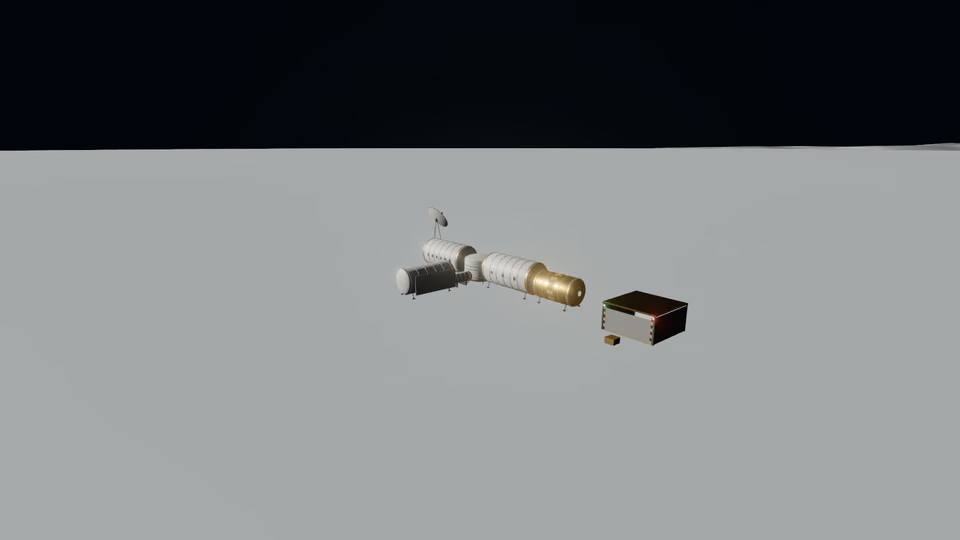
The station from the drone's approach
View
Camera 25 m above the ice, 92 m from the node.
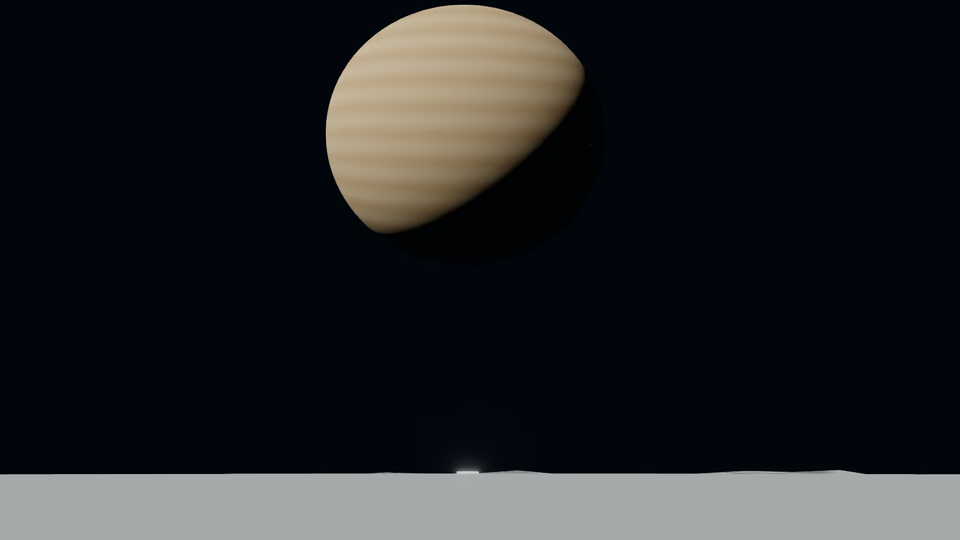
Habitation window: Saturn and the pad
View
From the habitation module's north window, eye 2.6 m above the ice, looking toward Saturn and the pad.
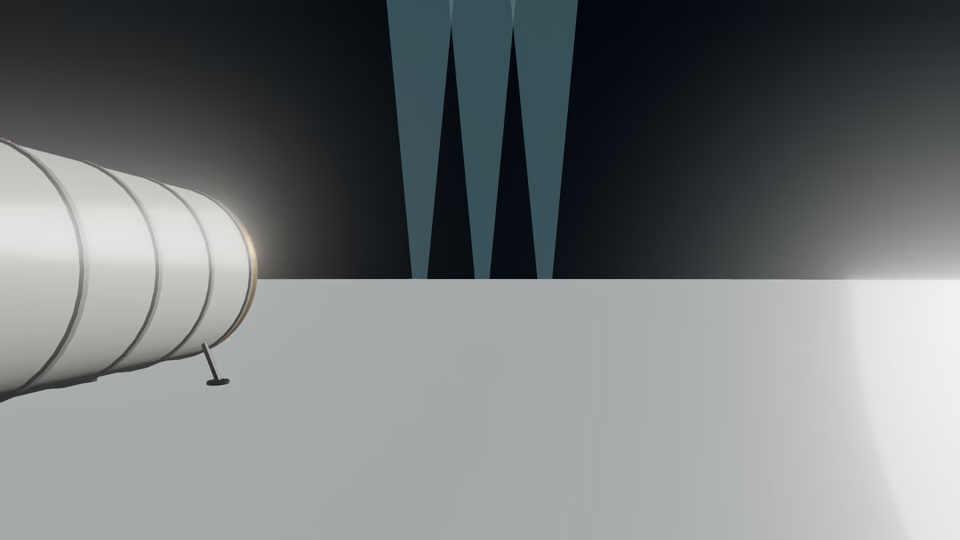
Habitation window: toward the plume field
View
From the habitation module's south window, eye 2.6 m above the ice, looking toward the plume field.
1. Saturn never moves
Habitation module
Enceladus keeps one face toward Saturn, and the station sits on that face at 54.5° south. Saturn hangs 35° above the northern horizon, 28° across, and never rises or sets. Its rings show as a thin line through the planet, because Enceladus orbits in their plane. The horizon is only about a kilometre away: this moon is 504 km across.
2. Samples never meet people
Sample containment and return bay
The plume carries grains of the ocean under the ice, and that ocean might hold life. Samples arrive sealed from the drone, go straight into this bay and are handled only by glovebox and robot. The laboratory sits between the bay and the living module, so nothing from the ocean passes where people sleep. The rule runs both ways: Earth's microbes must not reach that ocean either.
3. Why the pad is a kilometre away
Lander pad, bermed
Gravity here is about 1% of Earth's. A grain of ice kicked up by a landing engine at 10 m/s flies 0.9 km before it comes down, and anything faster than 239 m/s leaves Enceladus for good. So landers touch down 1 km from the station, behind a 4 m wall of piled ice, and crews ride across in a pressurised rover.
4. Sampling the plume
V8 sampling-drone hangar
The plumes rise from four long fractures near the south pole, the nearest 77 km from here. Seen from the station, a plume's 100 km level stands 38° above the southern horizon; the curve of the moon hides its lowest 12 km. The drone flies south through the falling plume material and brings the grains back sealed. No one walks to the vents.
5. Power in the dark
Fission power unit, shadow-shielded
Sunlight at Saturn is about 1% of Earth's, and at noon here the Sun climbs only 22° above the horizon. The station runs on a small fission reactor 400 m to the east, with its shield on the side facing the modules. A cable brings the power in; the distance and the shield together keep the crew's dose low.