Long Passage map: the fusion colony ship
The fusion colony ship that carries settlers from the inner system to Saturn: 650 m from the magnetic nozzle to the docking ring, 122 m across its habitat drums. Every part, distance and line of sight on these drawings comes from the layout the simulation is built from and checked against.
The ship
The drive is at the stern: the D-3He fusion core and its magnetic nozzle, 26 m across. Forward of it, a lithium-hydride shield 62 m across stands at station 118 m and casts a shadow that widens toward the bow; everything people use lives inside it. A spine truss 424 m long runs from the shield to the habitat drums and carries the radiators, 6 hydrogen tanks and the cargo for Titan. The drums turn opposite ways at 3 rpm, so their spins cancel. The engine gallery hangs 55 m off the axis on an outrigger, and the docking approach runs straight ahead of the bow.
Inside a habitat drum
Each drum is 122 m across and 40 m long. The floor is the inside of the drum, 56 m from the axis; at 3 turns a minute it moves at 17.6 m/s and presses on your feet at 0.56 g. Down is outward, and the floor curves up ahead and behind until it is overhead. A window ring 4 m wide in the floor shows the stars sweeping past once every 20 s. People cross between the drums along the still hub and the collar between them, without spinning.
What the engine gallery sees
The gallery is at station 392 m, 55 m off the axis. No straight line from it reaches the fusion core: the shield's rim is in the way. But a line that just clears the rim meets the axis 236 m behind the stern, so from the gallery the exhaust is in sight from there aft, with the radiators glowing alongside. The layout rule asks for the plume to be in sight beyond 400 m.
Looking aft from the gallery
What is drawn
- Spinning habitat drum
- Living deck
- Inhabited module: bridge, gallery
- Machinery, nozzle, bearings, berth
- Truss: spine, outrigger
- Cargo for Titan
- Fusion core
- Shadow shield
- Liquid-droplet radiator
- Hydrogen tank
- The shield's full shadow
- Docking approach
- Exhaust plume (styled)
- Sightline from the gallery
- Line past the shield's rim
- Line stopped by the shield
- Spin direction
- Window ring
- Ship's axis
- View field
- View (opens a still and the simulation)
- Inspect point
Rules the layout is checked against
| Rule | Limit | Measured | Basis | Why |
|---|---|---|---|---|
| drum spin rate | at most 3 rpm | 3 rpm | design | above the 2 rpm long-stay comfort limit: crossers adapt over the first days, the Gateway ring does not ask that of visitors |
| drum floor gravity, g | 0.3 to 0.7 g | 0.56 g | design | w^2 r = (0.3142 rad/s)^2 x 56 m = 5.53 m/s^2 = 0.56 g |
| gap between units that are not attached | 1 m | design | ||
| non-rotating hardware to the drums' swept volume (the bearings excepted) | 3 m | 4.0 m | design | |
| tanks, radiators, cargo, gallery, drums and bow inside the shield's full shadow | nothing outside it | 7.9 m inside the edge at the tightest | design | a 7 m core 40 m long behind a 31 m shield whose near face is 54 m forward of the core: the full shadow reaches 37 m from the axis where the radiators begin, 101 m at the gallery's window, 146 m at the aft drum's centre |
| from the engine gallery, the plume is in sight beyond this distance aft of the nozzle | 400 m | in sight from 236 m | physics | geometry |
The layout check (layout:clash) measures the ship against these and fails the build if one is broken. It passes.
Views and inspect points
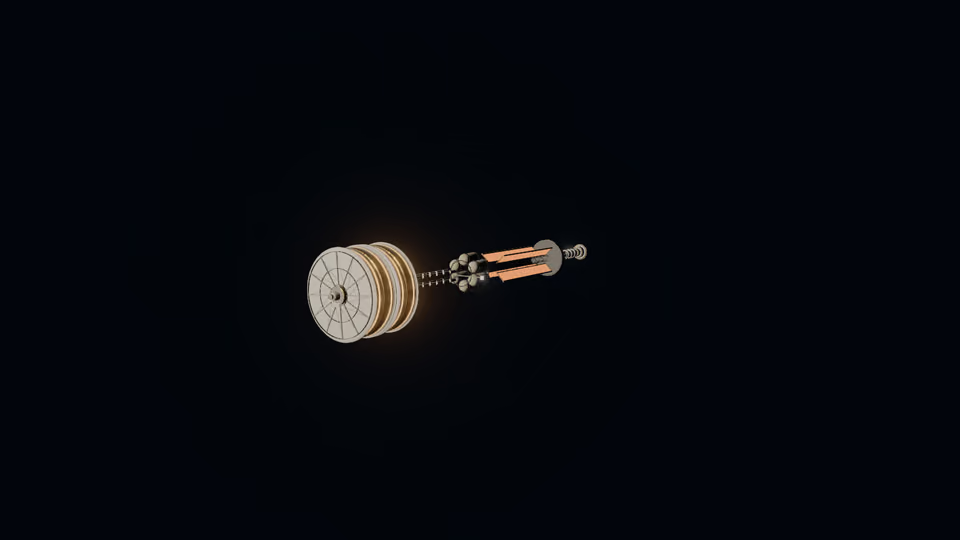
The whole ship
View
Camera 755 m ahead of the bow, 779 m off the axis, looking at a point 1,332 m away.
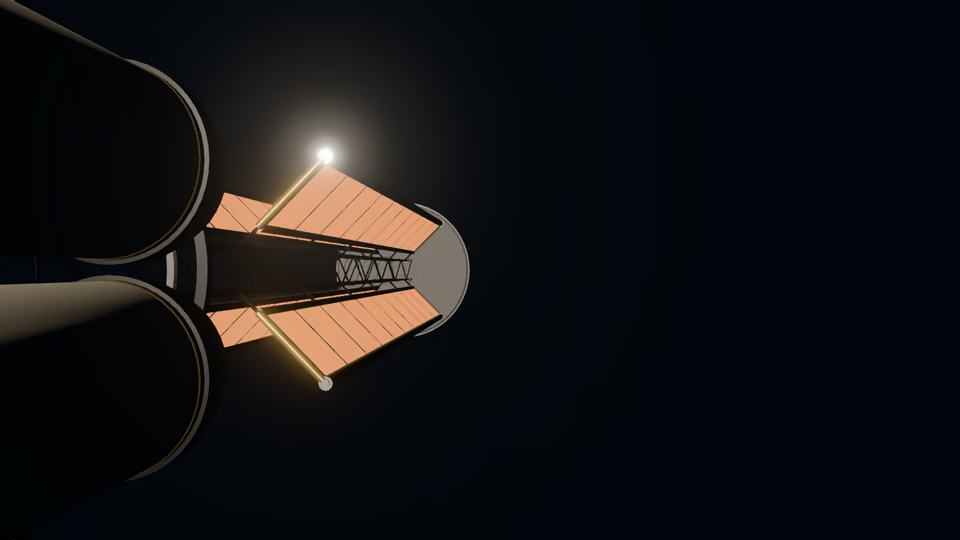
From the engine gallery, aft along the radiators
View
Camera at station 392 m, 55 m off the axis, looking at a point 794 m away.
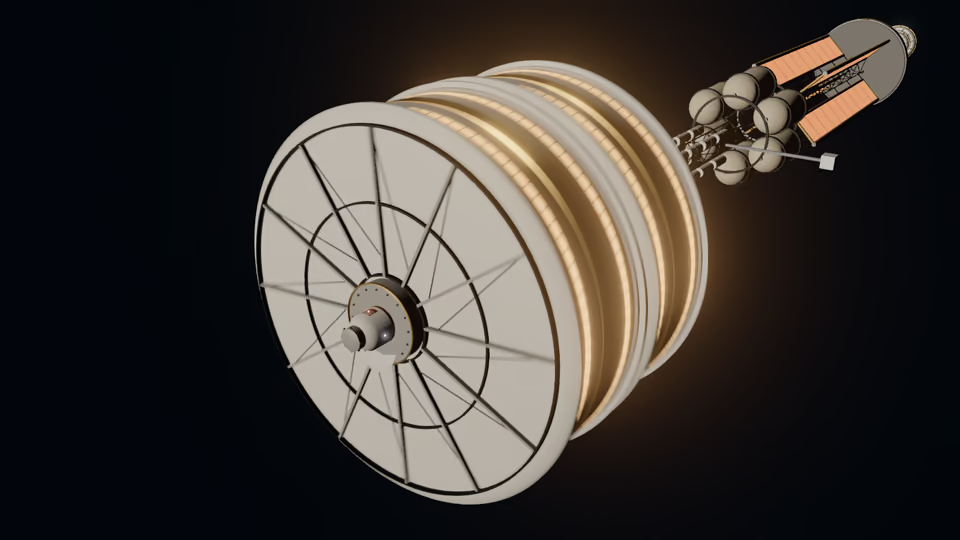
The counter-rotating drums
View
Camera 145 m ahead of the bow, 186 m off the axis, looking at a point 277 m away.
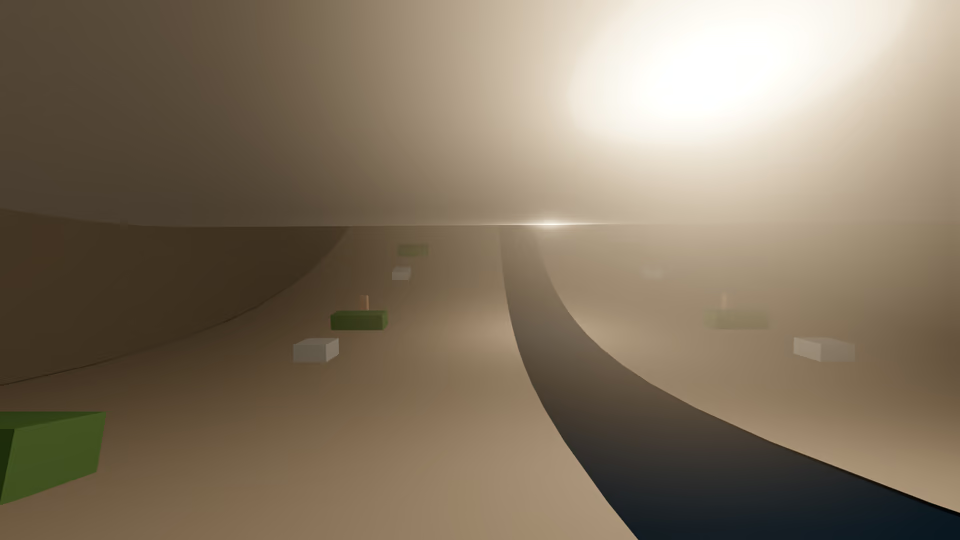
The drum promenade
View, inside a drum
Standing on the drum floor, eyes 1.7 m up, looking spinward as the floor curves up ahead.
1. Two drums turning opposite ways
Habitat drums
Each drum is 56 m in radius and turns three times a minute, giving 0.56 g on its floor. One turns clockwise and the other counter-clockwise, so their spins cancel and the ship can be pointed without fighting them. Between the drums a still collar carries the corridor along the axis, where people pass from one drum to the other without spinning.
2. Living in a shadow
Shadow shield
The fusion core sits about 480 m aft of the drums, behind a lithium-hydride shield 31 m in radius. Lithium hydride is light and rich in hydrogen, which slows neutrons. Everything people use lies in the shield's full shadow, where no straight line from any part of the core can reach: it extends 37 m from the axis at the radiators and 146 m at the drums.
3. Glowing at 1,200 K
Radiators
The drive makes about 10.6 GW of fusion power, and the part that does not leave in the exhaust has to be radiated away. These four strips of hot liquid droplets, 10,630 m² in all, glow orange at 1,200 K. Hot radiators can be small radiators: the power they shed rises with the fourth power of their temperature.
4. Reaction mass
Hydrogen tanks
Six tanks hold 3,935 tonnes of liquid hydrogen, 58,354 m³. The fusion fuel itself, deuterium and helium-3, is tiny by comparison: the whole crossing burns about 371 kg of it. The hydrogen is what the engine throws out of the back. The fusion energy is what makes it leave fast enough to cross to Saturn in about a year.
5. The plume, never the core
Engine gallery
The gallery hangs 55 m off the axis on an outrigger. That keeps it inside the shield's shadow, so the core is always hidden, but far enough out that a line of sight passes the shield's rim. Looking aft you see the radiators glowing alongside, and the exhaust from about 240 m behind the ship onward.
6. Weight from a turning floor
Drum: The floor curving up
This floor is the inside of a drum 56 m in radius that turns once every 20 seconds. It moves at 17.6 m/s, and pushing you round with it presses it against your feet at 0.56 times your Earth weight. Down is outward. Look ahead and the floor rises until it is overhead, where people walk upside down to you.
7. Walk spinward, weigh more
Drum: Breakfast tables
The spin adds a sideways push to anything moving. Walk spinward at an easy 1.3 m/s and you weigh 0.650 g; walk the other way and you weigh 0.483 g. Jump 0.76 m straight up and you land 0.35 m spinward of where you started: you keep the floor's sideways speed as you rise toward the axis, where the drum moves more slowly, so you drift ahead of it.
8. Stars below your feet
Drum: Floor window
The window ring in the floor looks straight out into space. Because the drum turns once every 20 seconds, the stars sweep past it at the same rate, a full circle of sky while you finish a sentence. The other drum turns the opposite way, so their spins cancel and the ship holds steady while the stars wheel.