Saturn Gateway map: a spinning orbital station
The Saturn Gateway circles Saturn 750,000 km out, once every 7.7 days: a truss that does not spin, where ships berth and fuel and cargo change hands, and a ring that does, so the people aboard have weight. Every part and distance on these drawings comes from the layout file the simulation is built from and checked against.
Along the spin axis
Seen along its axis, the station is mostly ring: 90 m from the axis to the floor, held by 3 spokes on a bearing at the hub. Everything that does not turn fits within 17 m of the axis. The observation compartment hangs on the Saturn side of the truss; the operations module faces away. Shuttles arrive along the lane pointing straight away from Saturn, 20 m in radius, and berth beside the truss; tugs come up the axis from below.
Side elevation
From the side the Gateway is a line 316 m long, 386 m with the tug docked. The truss runs 182 m down one side of the ring; the reactor sits 120 m up the other, on a boom, behind a shield. Its 8 MW of heat makes 2 MW of electricity, and the radiator wings shed the other 6 MW. The shield's full shadow is a cone that widens away from it, and every crewed space, both docked vehicles and the final approach of both lanes sit inside it.
Weight from spin
The ring makes weight by turning: 2 turns a minute on a 90 m radius presses the floor against your feet at 0.40 g. A smaller ring would have to spin faster for the same weight, and faster spin is what makes people dizzy when they turn their heads.
What is drawn
- Spinning: the ring and its spokes
- Crewed module
- Working module, hub bearing
- Truss, berths, antenna, cargo
- Methane depot tank
- Docked vehicle
- Radiator wing
- Shadow shield
- Fission reactor
- Reactor's full shadow
- Approach lane
- Observation window cone
- Camera view direction
- View (opens a still and the simulation)
- Inspect point
Rules the layout is checked against
| Rule | Value | Basis |
|---|---|---|
| ring spin rate (comfort for long stays) | at most 2 rpm (is 2 rpm) | design verify |
| ring floor gravity, g | 0.3 to 0.6 g (is 0.40 g) | design |
| gap between units that are not attached | 1 m | design |
| non-rotating hardware to the ring's swept volume (the hub bearing excepted) | 3 m | design |
| everything but the reactor, shield, boom and radiators inside the shield's shadow | inside, any margin | design |
| approach corridors clear of everything but their own berth's vehicle | inside, any margin | design |
| observation window: clear cone toward Saturn wider than the A ring (half-angle, degrees) | 12° | physics |
Measured on this layout by the check:
- closest non-rotating hardware to a spinning part: 6.5 m
- shadow: tightest margin 15.0 m inside the edge
- corridor radial: nearest hardware 50.0 m from the axis (radius 19.5 m)
- corridor axial: nearest hardware 74.0 m from the axis (radius 30 m)
- observation: clear 12° cone toward Saturn
- hero: Saturn 8.5° off axis, incoming craft 5° off axis at 323 m, station at 607 m
The layout check (layout:clash) fails the build if any of these is broken. "Verify" marks a number still to be confirmed against a source.
Views and inspect points
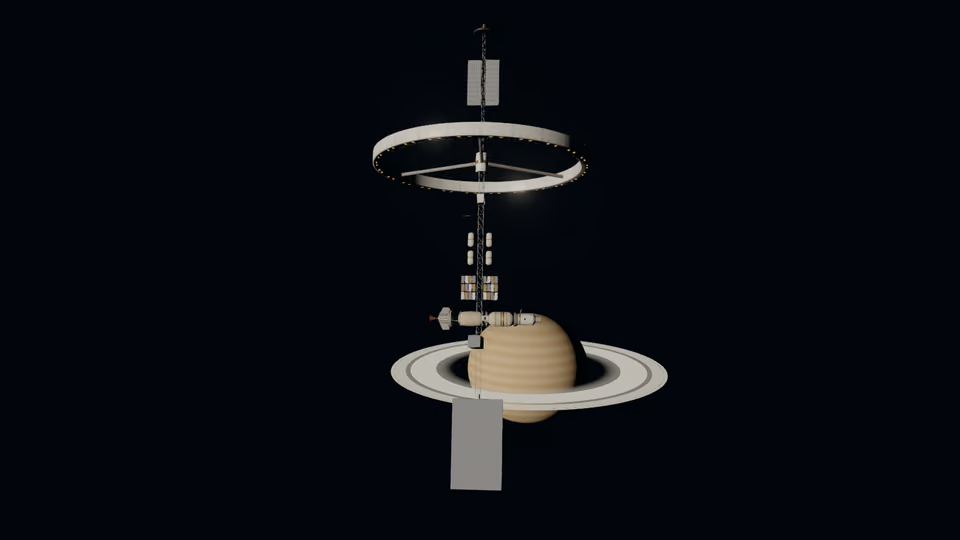
Arrival: shuttle, station, Saturn
View
Camera 625 m from the spin hub, looking at a point on the truss 607 m away.
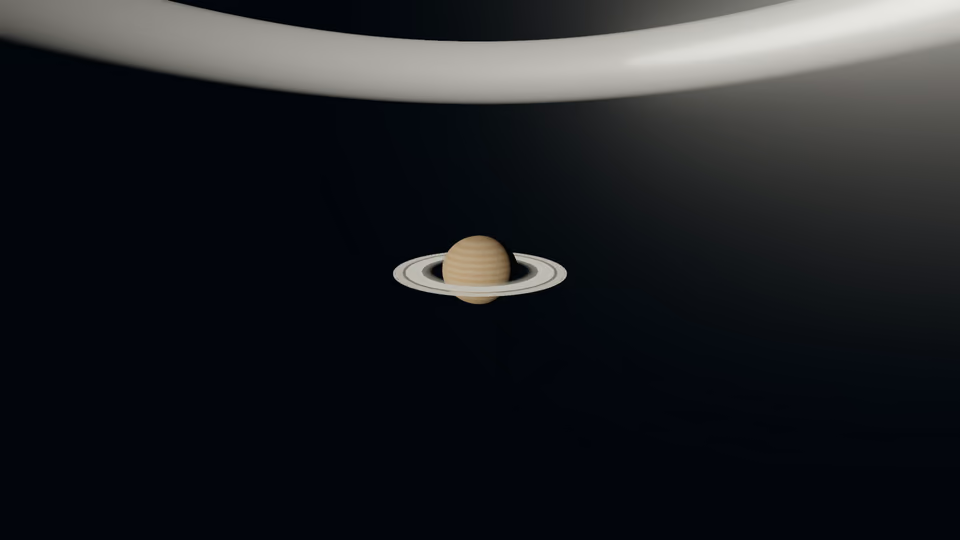
From the observation compartment
View
At the observation compartment's window, 32 m below the ring's plane, looking toward Saturn.
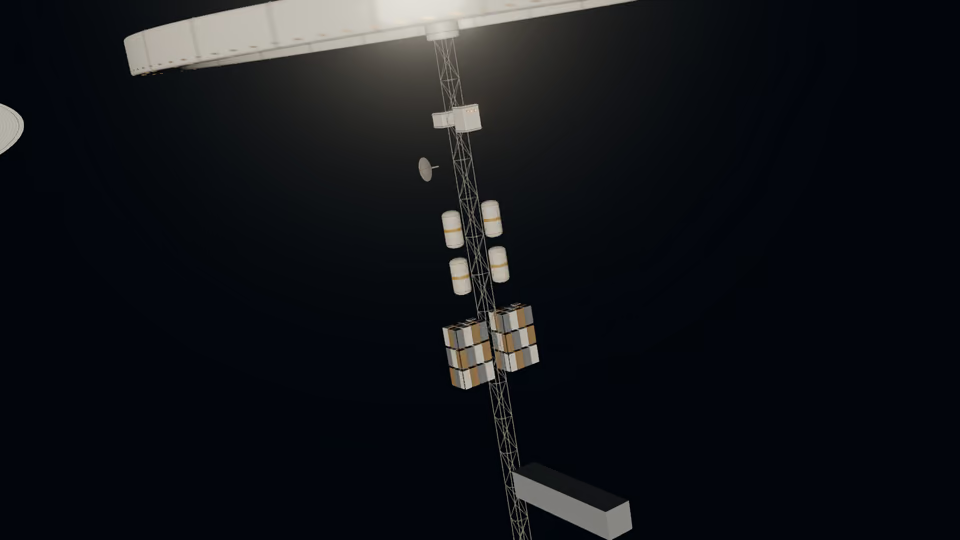
Along the truss from the sunlit side
View
Camera 311 m from the spin hub, looking at a point on the truss 318 m away.
1. Weight from spin
Habitation ring
The ring is 90 m in radius and turns twice a minute. That presses the floor against your feet at 3.95 m/s², 0.40 g, between Titan's 0.14 g and Earth's. Two turns a minute is slow enough that most people can turn their heads without feeling sick. The floor moves at 19 m/s, and a dropped cup lands a little spinward of the spot below your hand.
2. Where the spin stops
Spin bearing and transfer hub
The ring turns and the truss does not. They meet at this bearing, and people and cargo cross at the hub, near the axis, where the spin speed is close to zero. The ring's axis points at the pole of the station's orbit, which stays fixed in space, so holding it there costs no fuel. The truss turns slowly about the same axis, once every 7.7 days, to keep its window on Saturn.
3. Power where sunlight is weak
Fission power unit
At Saturn, sunlight is about 1% as strong as at Earth. Solar panels big enough for this station would cover nearly half a square kilometre. A small fission reactor gives 2 MW of electricity instead. It sits 120 m up the axis on a boom, and a shield 18 m across keeps every crewed space, and the last 250 m of every approach, in its shadow.
4. Getting rid of heat
Radiator wing
Turning heat into electricity wastes most of it. The reactor makes 8 MW of heat for 2 MW of power, and the other 6 MW must leave as infrared light. These panels run at 500 K, invisible to the eye, and need 941 m² to do it. In space there is no air to carry heat away, so radiating it is the only way out.
5. Fuel made on Titan
Methane depot tank
These four tanks hold Titan methane: two loads for the nuclear-thermal shuttles, about 410 tonnes. The methane comes from Kraken Mare, is processed at Kraken Shore and lifted to orbit by the ascent vehicles. A shuttle heats it in its reactor and throws it out of the nozzle; one trip from here to Titan orbit uses about 207 tonnes.
6. Arriving from above
Zenith berth
Shuttles come in along the line pointing straight away from Saturn and dock on this side of the truss. That keeps their path clear of the spinning ring and inside the reactor's shadow for the final 250 m. Departing shuttles back away to 300 m, turn sideways and only then light their engines, so the exhaust never points at the station.
7. A window on Saturn
Observation compartment
From 750,000 km, Saturn is 9.2° across, about 18 full Moons side by side, and its rings span 21°. The station's orbit is tilted 15° to Saturn's equator, so the rings are always seen a little open. The compartment hangs 32 m below the ring's plane, so the turning ring arcs overhead and never crosses the view.