Titan rotorcraft (V4)
Regional flight; the free-flight vehicle
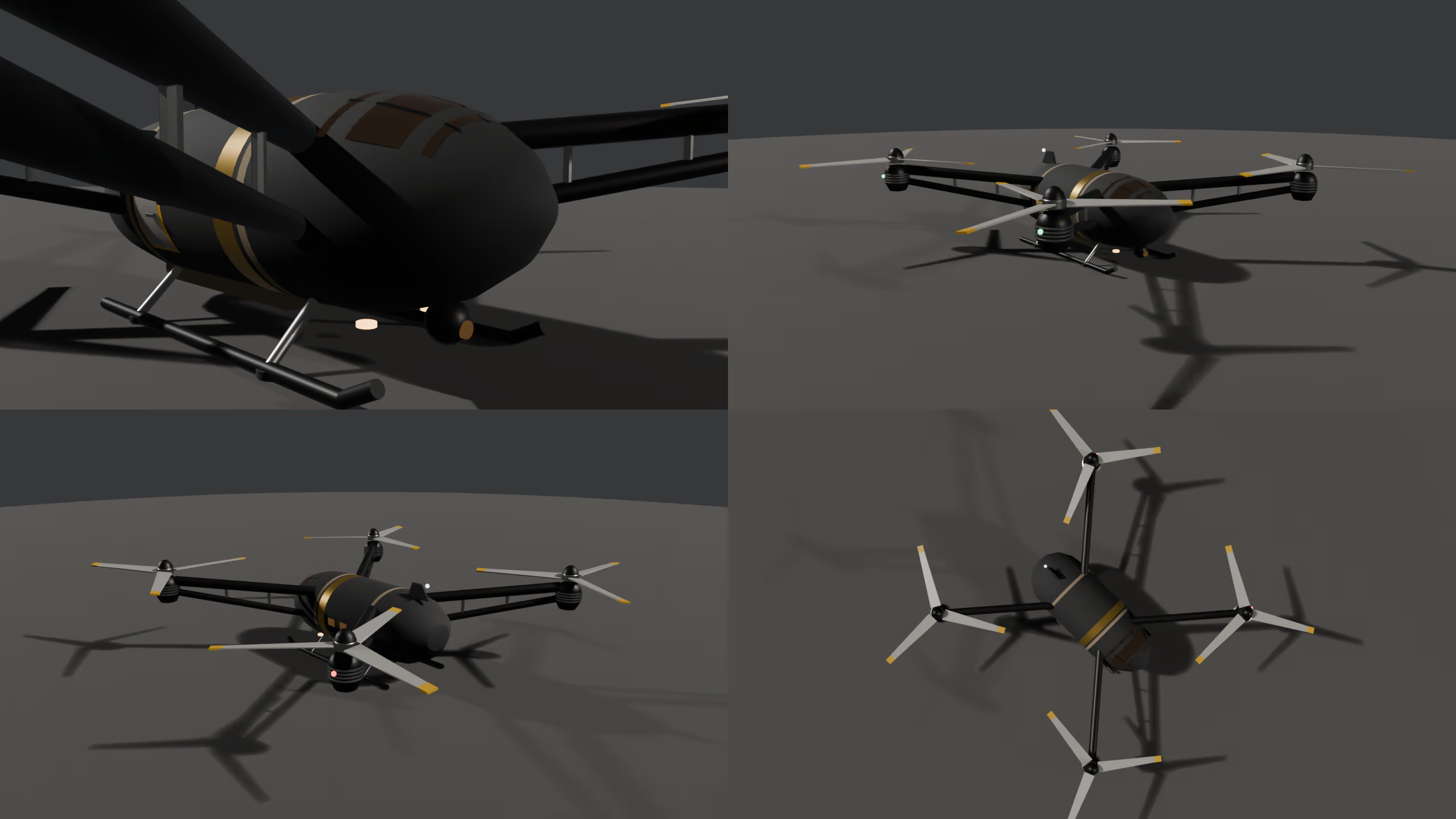
Regional flight; the free-flight vehicle. The regional aircraft and the one vehicle visitors fly themselves. Dense cold air and weak gravity make hovering cheap, so the rotorcraft carries 8 tonnes on four 7 m rotors for about forty times less power than on Earth.
Propulsion: Electric quad-rotor, reactor-charged battery. Envelope: 18 m long by 18 m maximum diameter design
All input and derived values below are read from assets/data/vehicles.json, generated by scripts/analysis/vehicle_budget.py. Values marked “verify” are not established facts.
Open the 3D model See it in the tour How the propulsion works
Inputs
| Input | Value | Basis and notes |
|---|---|---|
| Mass, kg | 8,000 | design |
| Rotors | 4 | design |
| Rotor diameter, m | 7 | design |
| Figure of merit | 0.7 | physics |
| Air density, kg/m³ | 5.4 | physics Fulchignoni et al. 2005, Nature 438, 785 (HASI surface pressure and temperature) |
| Gravity, m/s² | 1.352 | physics https://nssdc.gsfc.nasa.gov/planetary/factsheet/saturniansatfact.html |
Derived performance
| Quantity | Value |
|---|---|
| Disc area, m² | 153.9 |
| Hover power Titan, kW | 39.4 |
| Hover power same craft on Earth, kW | 1,616 |
| Earth to Titan power ratio | 41 |
| Battery for 2h, kWh | 95 |