Home / Chemistry / Inside the flame
Inside the flame
In the ascent engine, methane and oxygen swap partners at roughly 3,500 K, and the swap releases 802 kJ for every mole of methane.
See it in the tour: chapter how it survives, shot 7.5.
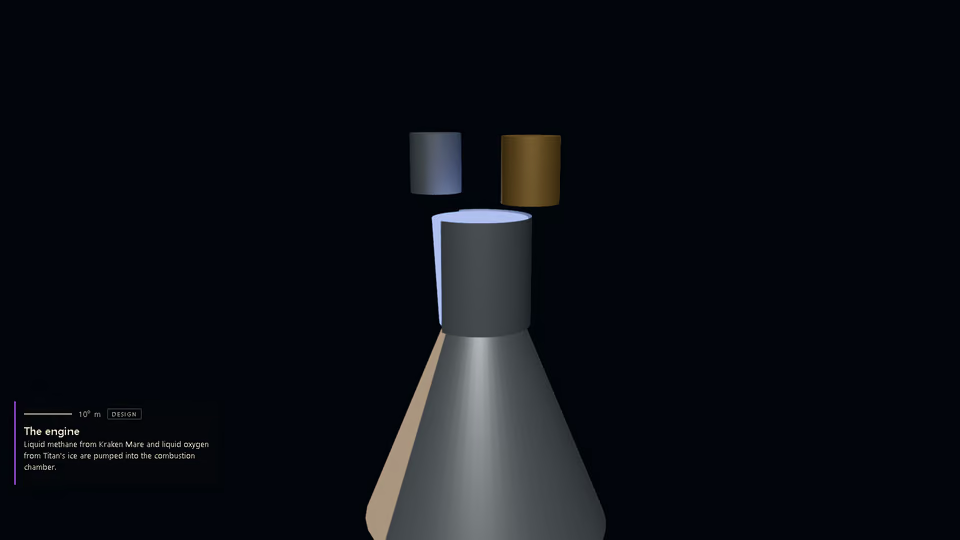
The engine
One ascent-vehicle launch burns 14.0 t of methane from the sea with 50.3 t of oxygen from the ice design. Pumps push both liquids into one chamber and the engine makes 221 kN design.
The injector
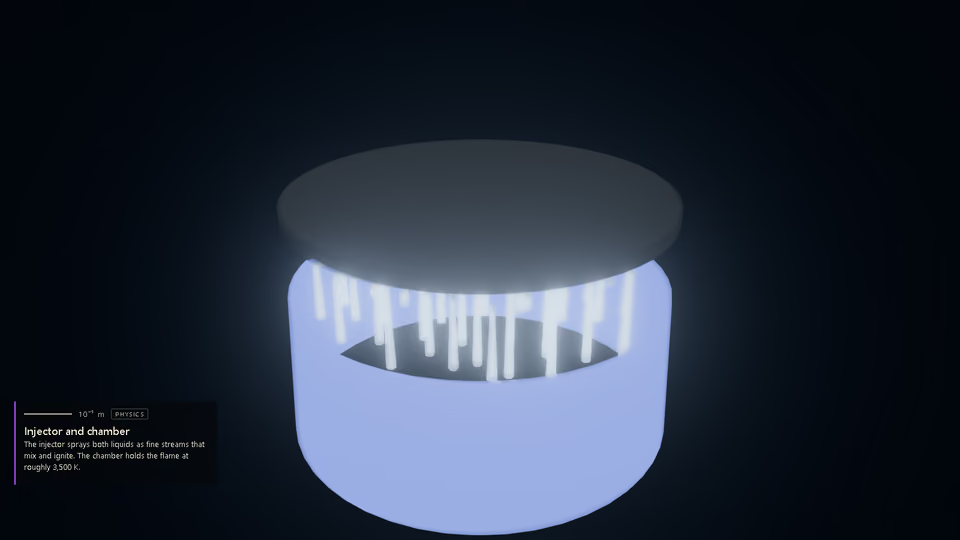
The injector face sprays both liquids as fine streams that mix as they leave physics.
The flame front
The chamber holds the flame at roughly 3,500 K physics. The burn happens in a thin front where cold propellant becomes hot gas. Short-lived fragments of molecules, the radicals OH and CH, appear there physics. Excited CH glows near 431 nm, which is why the flame is blue-violet physics.

Bonds break and re-form
At the scale of a nanometre the burn is one equation:
CH₄ + 2 O₂ → CO₂ + 2 H₂O
Six bonds break, four C–H in methane and two O=O in the oxygen. Six bonds form, two C=O in carbon dioxide and four O–H in the water physics. The new bonds are stronger than the old ones, and the difference leaves as heat: 802.3 kJ per mole of methane burned physics.
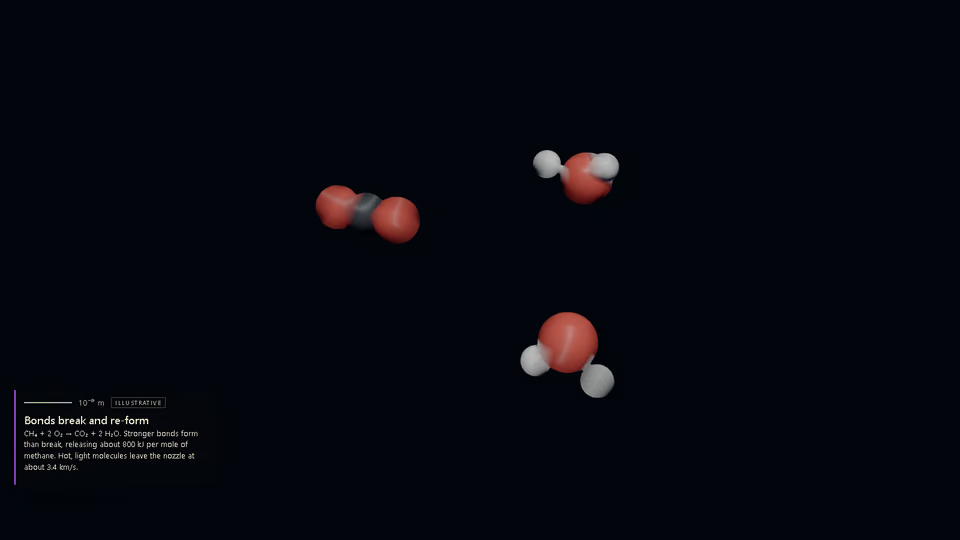
CH₄ + 2 O₂ → CO₂ + 2 H₂O
Bonds broken: 4 C–H, 2 O=O. Bonds formed: 2 C=O, 4 O–H.
- 10⁰ m The engine
- 10⁻¹ m Injector and chamber
- 10⁻³ m The flame front
- 10⁻⁹ m Bonds break and re-form
The card plays the same script as the tour. The flash is the moment of collision, the OH is the intermediate, and the energy bar fills as the products leave.
Where the mass goes
A mole of methane and two of oxygen weigh 80.04 g before the burn and 80.04 g after. Chemistry loses mass too, but 802.3 kJ divided by the speed of light squared is 8.9 nanograms physics. No balance sees it. Fusion loses 0.4% of its fuel's mass physics, which is why it is a different kind of engine. See Fusion propulsion and helium-3.
What leaves the nozzle
Hot, light molecules, water and carbon dioxide, leave at about 3.4 km/s, a specific impulse of 345 s physics. The whole chain from sea and ice to this flame is in Methalox from Titan, and what the oxygen costs is in Fire on Titan.
Key numbers
| Quantity | Value | Basis |
|---|---|---|
| Reaction | CH₄ + 2 O₂ → CO₂ + 2 H₂O | physics |
| Bonds broken / formed | 6 / 6 | physics |
| Energy released | 802.3 kJ per mole of methane | physics |
| Flame temperature | about 3,500 K | physics |
| Mass converted per mole burned | 8.9 ng | physics |
| Exhaust speed / specific impulse | about 3.4 km/s / 345 s | physics |
| Propellant per launch | 14.0 t methane, 50.3 t oxygen | design |
| The reaction card | drawn from the DZ1 script | illustrative |
Sources
- NIST Chemistry WebBook, methane (enthalpy of formation)
- NIST Chemistry WebBook, carbon dioxide
- NIST Chemistry WebBook, water
- EUCASS 2016 proceedings, paper 8-129, a methane and oxygen combustion chamber (maximum combustion temperature 3,600 K)
- NASA, Titan facts