Home / Chemistry / Fire on Titan
Fire on Titan
On Titan the fuel is free and the oxygen is the cost, so every fire starts at the oxygen tank.
See it in the tour: chapter cold industry, shot 5.3.
The fire triangle, turned over
A fire needs fuel, oxygen and a spark. On Earth the air is a fifth oxygen and the fuel is what you dig up. On Titan it is the other way round. Methane is 5.65% of the air near the ground and fills the sea physics. There is no free oxygen to burn it with physics.
So nothing on Titan burns by itself, and a match would not light. Fire is something the settlers carry in, as liquid oxygen. See Titan, a chemistry set.
What the oxygen costs
Every kilogram of methane burned needs 3.99 kg of oxygen physics. Splitting that oxygen out of ice takes at least 71.3 MJ, because each kilogram costs 17.9 MJ physics. Burning the methane returns 50.0 MJ physics.
The oxygen costs more than the fire gives back, a ratio of 1.4. Methalox on Titan stores reactor power; it does not add to it physics. The hydrogen that comes off the same cells is not burned. It goes to the fusion transports as reaction mass design. The numbers per launch are in Methalox from Titan.
Where fire is allowed
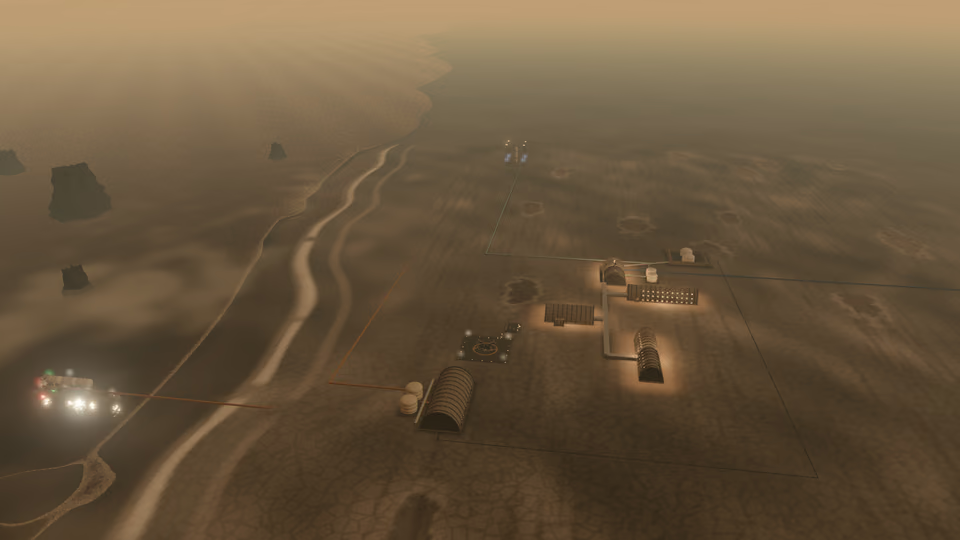
The plant keeps the two halves of the triangle apart design.
- The processing hall stands well apart from the homes. Hydrocarbons and the oxygen-rich air indoors must never meet design.
- The pad has a keep-out. 480 m to inhabited buildings and 288 m to working buildings design.
- Liquid oxygen stays in its tanks. It sits near its boiling point, 90.2 K at one atmosphere, in air that is 94 K physics.
Leaks run the other way
The halls hold 1 bar and Titan's air outside is at 1.467 bar design. A leak admits the outside air. It does not lose the room's air outward. See Building for 94 K and 1.5 bar.
That matters because methane in air burns between 5.0% and 15% by volume physics. Titan's air, at 5.65%, sits just above the lean limit physics. It is harmless outside, with no oxygen in it. Let it into a room with oxygen-rich air and the mixture can burn. The limiting oxygen concentration for methane is 12% physics, and the indoor air is well above it design.
The same arithmetic runs outdoors. A liquid-oxygen spill brings the missing ingredient to air that already holds about 5% methane. That is why the hall, the tanks and the pad each get their own distance.
Key numbers
| Quantity | Value | Basis |
|---|---|---|
| Methane near the surface | 5.65% of the air | physics |
| Methane flammable in air | 5.0% to 15% by volume | physics |
| Limiting oxygen concentration, methane | 12% | physics |
| Oxygen per kg of methane burned | 3.99 kg | physics |
| Energy to make that oxygen / energy released | at least 71.3 MJ / 50.0 MJ | physics |
| Liquid oxygen boiling point at 1 atm | 90.2 K | physics |
| Pad keep-out, homes / working buildings | 480 m / 288 m | design |
| Indoor / outdoor pressure | 1 bar / 1.467 bar | design |
Sources
- Zabetakis 1965, Flammability characteristics of combustible gases and vapors, US Bureau of Mines Bulletin 627
- Niemann et al. 2010, Composition of Titan's lower atmosphere (Huygens GCMS), JGR 115, E12006
- NIST Chemistry WebBook, water (enthalpy of formation, liquid)
- NIST Chemistry WebBook, methane