Home / Chemistry / Titan, a chemistry set
Titan, a chemistry set
Titan hands over nitrogen and carbon almost free, and the settlers spend their power on the one thing it lacks, which is oxygen.
See it in the tour: chapter cold industry, shot 5.2.
Three ingredients
Titan's surface sits at 93.65 K and 1.467 bar physics. Three materials cover it.
- Air. About 95% nitrogen and 5% methane physics. Near the ground the methane is 5.65% physics.
- Sea. Liquid methane and ethane with nitrogen dissolved in them. Cassini's radar read Ligeia Mare as 71% methane, 12% ethane and 17% nitrogen by volume physics. Kraken Mare reads like Ligeia and is methane-dominated, but its own split has not been measured physics.
- Ice. Water ice is the bedrock physics. At 94 K it does the job of rock.
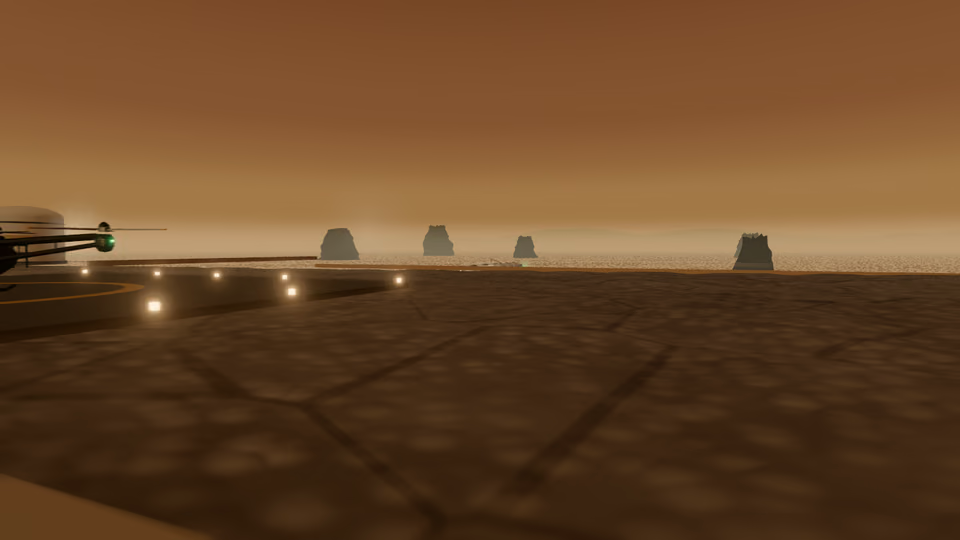
What is free and what is made
These three hold four light elements, and the settlement is built from them. Metals, electronics and specialised machinery come in through the Gateway fiction.
Nitrogen is a pump away. Carbon is a hose away, in the sea, and the air carries some too. Hydrogen is locked in methane and in ice, one part in nine of water by mass physics, so it has to be pulled out with heat or electricity. The plant does it by electrolysis of ice or by cracking methane. See Nitrogen into ammonia.
Oxygen is the scarce one
Titan's air holds no free oxygen. The oxygen species in it are traces: carbon monoxide at about 40 ppm, and less carbon dioxide and water physics. All the oxygen within reach is in the ice, eight parts in nine of water by mass physics. Pulling it out costs at least 17.9 MJ per kilogram physics.
That one number shapes the economy. Methane is cheap, so every burner on Titan is short of oxygen, not fuel. See Fire on Titan and Water, oxygen and electrolysis.
Where each page picks up
- The sunlight that turns the air orange also destroys its methane: The orange sky.
- The sea has to be sorted into methane, ethane and nitrogen: Sorting the sea.
- Nitrogen and hydrogen become fertiliser, and ethane becomes plastic: Nitrogen into ammonia and Plastics from the sky.
- Methane and oxygen meet in the engine: Inside the flame.
Every reaction on these pages plays in the reaction lab.
Key numbers
| Quantity | Value | Basis |
|---|---|---|
| Surface temperature / pressure | 93.65 K / 1.467 bar | physics |
| Air | about 95% nitrogen, 5% methane | physics |
| Methane near the surface | 5.65% | physics |
| Ligeia Mare, by volume | 71% methane, 12% ethane, 17% nitrogen | physics |
| Carbon monoxide in the air | about 40 ppm | physics |
| Oxygen share of water by mass | 8/9 | physics |
| Least energy to split out oxygen | 17.9 MJ per kg | physics |
Sources
- NASA, Titan facts
- Niemann et al. 2010, Composition of Titan's lower atmosphere (Huygens GCMS), JGR 115, E12006
- Hayes 2016, The Lakes and Seas of Titan, Annual Review of Earth and Planetary Sciences 44
- Birch, Hayes and Perron 2025, Titan's Fluvial and Lacustrine Landscapes
- NIST Chemistry WebBook, water (enthalpy of formation)