Home / Chemistry / The orange sky
The orange sky
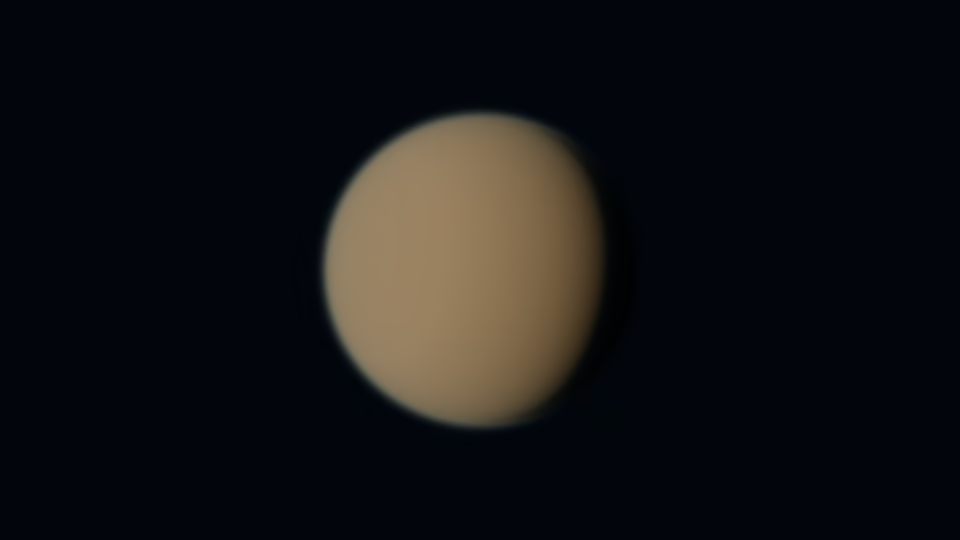
Titan's colour is made of its own methane. Sunlight breaks it, the pieces link up, and the haze they form stops blue light first.
See it in the tour: chapter into titan, shot 3.1.
Methane does not last
Methane is 5.65% of the air near the ground physics. High in the atmosphere, ultraviolet sunlight at 121.6 nm, the solar Lyman-alpha line, and charged particles break it apart physics. At the present rate the air's methane is destroyed in about 30 million years physics. That is brief on a planet's clock, so something must resupply it physics.
From methane to haze
The broken pieces link up. Cassini's instruments traced the chain from methane and nitrogen through molecules of 80 to 350 daltons to heavy, negatively charged molecules of about 8,000 daltons physics. They form near 1,000 km, far higher than anyone had assumed before the flybys physics.
Those molecules grow into particles and sink. Haze runs from the top of the air all the way to the ground physics. A detached layer floated near 500 km in 2004 to 2007, was gone by 2012, and is not there on the reference date physics.
What a tholin is
Carl Sagan and Bishun Khare coined the word in 1979 for the brown organic solids that form when energy passes through mixtures of methane and other simple gases physics. By convention the lab material is the tholin and Titan's own particles are the haze physics. Both are organic, and both carry nitrogen.
Why the sky is orange
The haze stops light unevenly. Its opacity falls steeply with wavelength, as the wavelength to the power minus 2.34 physics. Blue is blocked highest in the column and red reaches deepest, so the limb looks blue and the disc looks orange illustrative. On the way down, blue light is stopped about 160 km up and red about 131 km up illustrative. Only perhaps 10% of the sunlight that reaches Titan gets to the ground physics.
Where it all goes
Haze settles on the ground and the seas. Ethane, the other product, condenses and falls into the seas physics. Rain brings back the methane that has not been destroyed physics. The settlement lifts methane and ethane out of the sea by the barge-load. See Sorting the sea and Plastics from the sky.
Key numbers
| Quantity | Value | Basis |
|---|---|---|
| Methane near the surface | 5.65% | physics |
| Photolysis wavelength | 121.6 nm | physics |
| Methane lifetime without a source | about 30 million years | physics |
| Heavy ions | about 8,000 daltons near 1,000 km | physics |
| Detached haze | about 500 km (2004 to 2007), absent on the reference date | physics |
| Haze opacity against wavelength | wavelength to the power −2.34 | physics |
| Blue / red stopped at | about 160 km / 131 km | illustrative |
| Sunlight reaching the ground | perhaps 10% | physics |
Sources
- Niemann et al. 2010, Composition of Titan's lower atmosphere (Huygens GCMS), JGR 115, E12006
- Horst 2017, Titan's atmosphere and climate, JGR Planets 122, 432
- Waite et al. 2007, The process of tholin formation in Titan's upper atmosphere, Science 316, 870
- NASA, Cassini reveals evidence of tholin formation at high altitudes in Titan's atmosphere
- Sagan and Khare 1979, Tholins, Nature 277, 102
- NASA, Titan, the complex anti-greenhouse (PIA06236)
- West et al. 2018, The seasonal cycle of Titan's detached haze, Nature Astronomy 2, 495