Home / Nuclear / Deuterium from ice
Deuterium from ice
The ship's deuterium is already flowing through the Kraken Shore plant, hidden in the water that becomes oxygen and hydrogen.
See it in the tour: chapter ocean beneath ice, shot 8.2.
A little in every molecule
Deuterium is hydrogen with a neutron in the nucleus. In Earth's oceans there is one deuterium atom for every 6,420 ordinary hydrogen atoms, a ratio of 155.76 per million physics. That makes ocean-grade water 34.8 g of deuterium per tonne physics.
The Long Passage burns 149 kg of deuterium on a crossing, half of the fuel's atoms and 40% of its mass physics. At ocean grade that is 4,265 tonnes of water, if every atom came out physics.
The ratio at Saturn
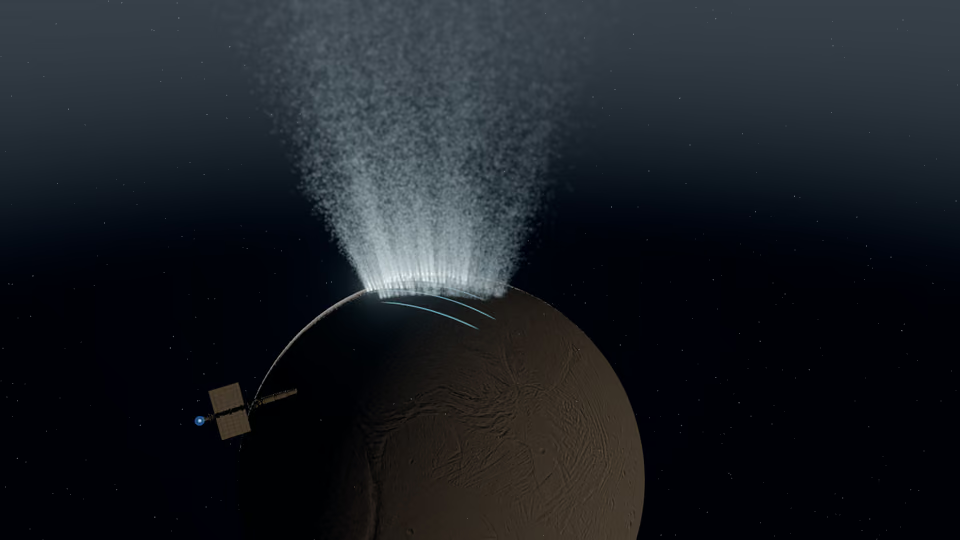
One measurement exists for Saturn-system ice. Cassini's mass spectrometer flew through the Enceladus plume and read a ratio of 2.9 per ten thousand, with a range from 2.2 to 4.4, about twice Earth's physics. It is one flyby with a wide error bar. The low end is still above the oceans physics. Jupiter's hydrogen gas, measured by the Galileo probe, is the other way: 2.6 per hundred thousand, a sixth of Earth's physics.
So the plan uses the ocean value as the working figure, and treats the plume as upside design.
Already in the plant
The Kraken Shore plant splits ice into oxygen for the ascent vehicle and hydrogen for the fusion transports design. A Long Passage tank load is 3,935 tonnes of hydrogen, which came from about 35,400 tonnes of water design. At ocean grade that hydrogen carries 1.2 tonnes of deuterium, eight times a crossing's burn physics. The deuterium is already in the stream. It has to be pulled out. See Water, oxygen and electrolysis.
Two ways to pull it out
Electrolysis. This is the old way. In 1932 Washburn and Urey showed that electrolysing water leaves the heavy isotope piling up in the water that remains, because the hydrogen gas leaves slightly poorer in deuterium than the liquid it came from physics. The plant's cells can run to partial conversion and bleed the enriched water to a second stage design.
Chemical exchange. The second stage is a hydrogen sulfide and water exchange between two towers, one cold at 30 °C and one hot at 130 °C. Deuterium prefers water at the cold temperature and hydrogen sulfide at the hot one. Pass the two streams past each other and each pass enriches the water a little more physics. Stages stack in a cascade until the water is nearly pure D₂O physics. Electrolysis of that water gives deuterium gas for the drive design.
The hot tower needs steady heat. At Kraken Shore waste heat from the reactors is a resource rather than a burden, so the exchange runs in a warm hall behind the berm design. See Reactors and heat on Titan. A chemical process on ice feeds a nuclear process in space.
Key numbers
| Quantity | Value | Basis |
|---|---|---|
| Deuterium per hydrogen, Earth's oceans | 155.76 × 10⁻⁶ | physics |
| Deuterium per tonne of ocean water | 34.8 g | physics |
| Deuterium per hydrogen, Enceladus plume | 2.9 × 10⁻⁴ (2.2 to 4.4) | physics |
| Deuterium per hydrogen, Jupiter | 2.6 × 10⁻⁵ | physics |
| Deuterium per crossing | 149 kg | physics |
| Water holding that deuterium, ocean grade | 4,265 t | physics |
| Hydrogen reaction mass per crossing | 3,935 t from about 35,400 t of water | design |
| Deuterium in that hydrogen, ocean grade | about 1.2 t | physics |
| Exchange towers | 30 °C and 130 °C | physics |
Sources
- Hagemann, Nief and Roth 1970, Absolute isotopic scale for deuterium analysis of natural waters, Tellus 22, 712
- Waite et al. 2009, Liquid water on Enceladus from observations of ammonia and 40Ar in the plume, Nature 460, 487
- NIST, Harold Urey, Ferdinand Brickwedde and the discovery of deuterium
- US patent 4,125,598, Method for heavy-water production by H2S-H2O chemical exchange process
- Mahaffy et al. 1998, Galileo probe measurements of D/H and 3He/4He in Jupiter's atmosphere