Home / Nuclear / Inside the fusion drive
Inside the fusion drive
Zoom from the whole ship to one nucleus and watch 0.39% of the fuel's mass leave as motion.
See it in the tour: chapter long passage, shot 0.7.
The deep zoom in the tour has four rungs. This page walks them in order and then does the arithmetic the last one only shows.
Step 1: the ship
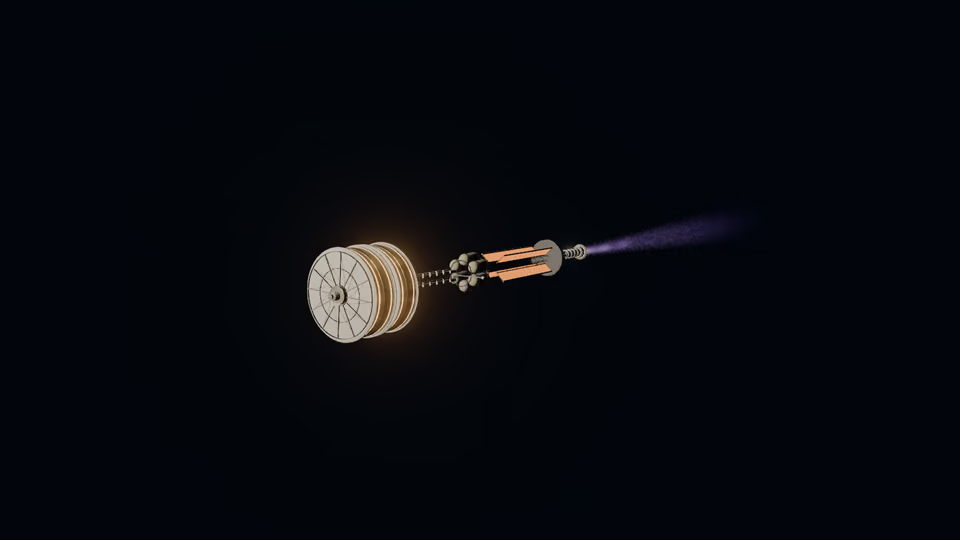
The Long Passage is 650 m long and 122 m across design. Her engine sits at the stern, far from the people. It pushes with 63.7 kN, an exhaust speed of 200 km/s and 10.6 GW of fusion power challenge. Everything else on the truss, the shield, the radiators, the tanks, exists to serve or to hide that one machine.
Step 2: the magnetic nozzle
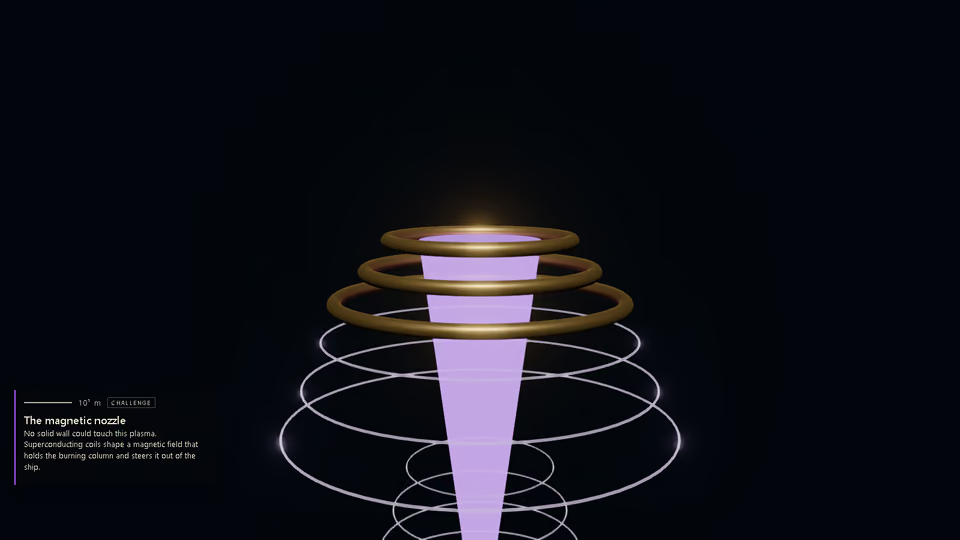
At the scale of ten metres the engine is a ring of three superconducting coils, 13 m in radius design. No solid wall could touch the plasma inside. A charged particle cannot cross a magnetic field line, it spirals along it physics. So the field is the container, and the same field, opening toward the stern, is the nozzle challenge.
Step 3: the plasma
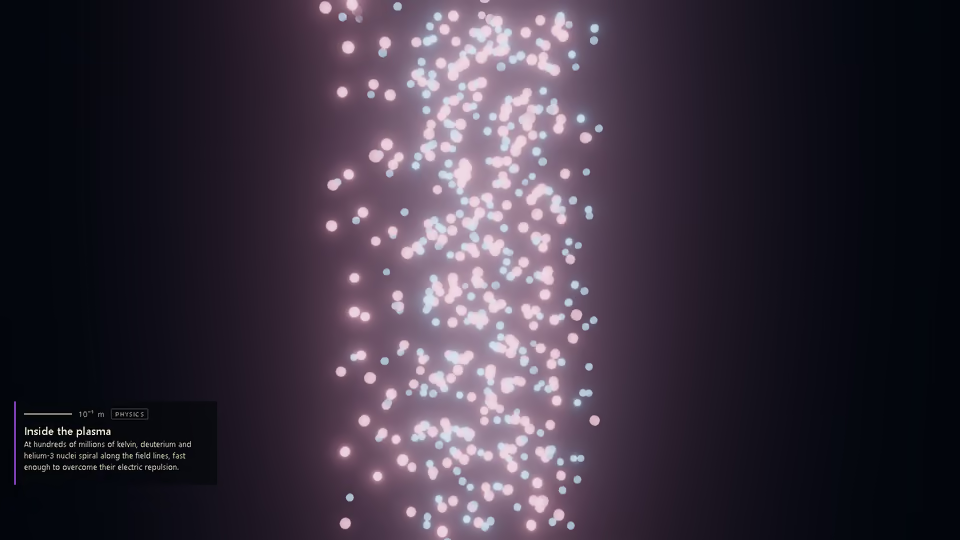
At ten centimetres the column is a gas of bare nuclei, deuterium and helium-3, at hundreds of millions of kelvin physics. Both carry positive charge and repel each other. Only the fastest pairs get close enough for the short-range nuclear force to win. Most meetings change nothing, and the nuclei spiral on until the next one physics.
Step 4: the nuclei
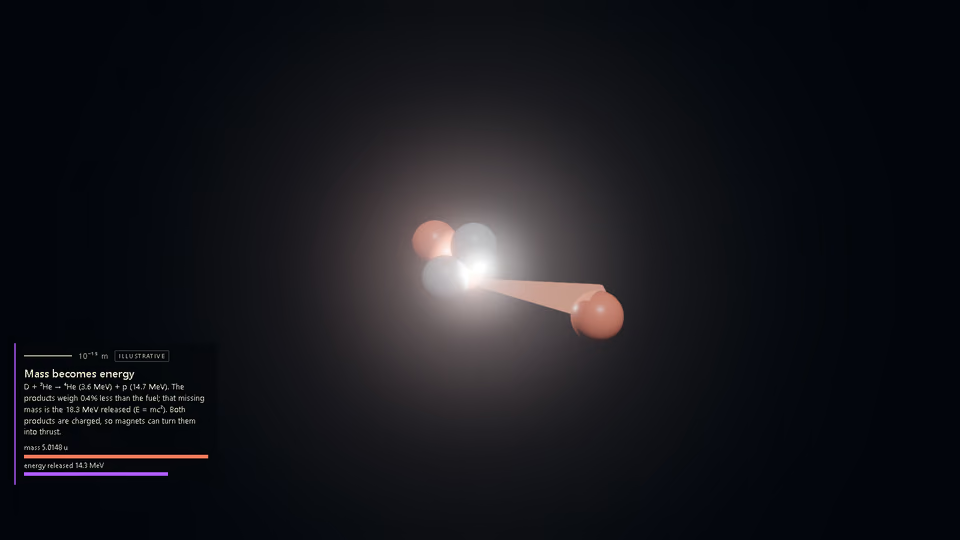
The last rung is drawn at 10⁻¹⁵ m. A deuteron and a helion merge and two things leave: a helium-4 nucleus and a proton illustrative. The picture is a diagram, not a photograph. The arithmetic behind it is not.
The mass defect, worked
- Weigh the fuel. Deuterium is 2.014102 u and helium-3 is 3.016029 u, 5.030131 u together physics.
- Weigh the products. Helium-4 is 4.002603 u and a proton, as a hydrogen atom, is 1.007825 u, 5.010428 u together physics.
- Subtract. The products weigh 0.019703 u less, 0.39% of the fuel physics.
- Convert. One atomic mass unit is 931.494 MeV, so the missing mass is 18.35 MeV physics.
- Share. The fuel starts nearly at rest, so the two products leave with equal and opposite momentum. The light proton moves fast and takes about 80% of the energy, 14.7 MeV. The helium nucleus takes the other 3.7 MeV physics.
Both products are charged, so the magnetic nozzle can steer both. That is the whole case for this fuel. A neutron would take its share straight through the coils, which is the subject of Shadow shields and neutrons.
What one kilogram buys
Per kilogram of fuel the reaction gives 3.5 × 10¹⁴ J physics. A crossing burns about 371 kg challenge. Compare that with chemistry on Energy per kilogram, and see where the fuel comes from in Helium-3 from Saturn and Deuterium from ice.
Key numbers
| Quantity | Value | Basis |
|---|---|---|
| Fuel mass, D + ³He | 5.030131 u | physics |
| Product mass, ⁴He + p | 5.010428 u | physics |
| Mass lost | 0.019703 u, 0.39% | physics |
| Energy released | 18.35 MeV | physics |
| Proton / helium-4 share | 14.7 MeV / 3.7 MeV | physics |
| Nozzle coils | 3, 13 m radius | design |
| Thrust / exhaust speed | 63.7 kN / 200 km/s | challenge |
| Fusion power | 10.6 GW | challenge |
Sources
- Razin et al. 2014, A direct fusion drive for rocket propulsion, Acta Astronautica 105
- Wang et al. 2021, The AME 2020 atomic mass evaluation (II), Chinese Physics C 45, 030003
- NIST, CODATA fundamental physical constants