Home / Nuclear / Shadow shields and neutrons
Shadow shields and neutrons
A clean fuel still leaks a few neutrons, and a neutron is the one product no magnet can steer, so a disc 62 m across hides the core from everyone.
See it in the tour: chapter long passage, shot 0.4.
Clean is not neutron-free
The main reaction, deuterium plus helium-3, releases two charged particles and no neutron physics. But the plasma holds deuterium, and deuterium nuclei meet each other too. Three side reactions follow physics.
| Reaction | Energy | Neutron's share |
|---|---|---|
| D + D → ³He + n | 3.27 MeV | 2.45 MeV |
| D + D → T + p | 4.03 MeV | none |
| D + T → ⁴He + n | 17.59 MeV | 14.05 MeV |
The second branch makes tritium, and the tritium fuses with deuterium in turn. So some reactions in the plasma yield a neutron, and one kind carries 14 MeV, most of the energy of a whole main reaction physics. The numbers come from the mass lost in each reaction, as on Inside the fusion drive. Here are the first and the last, played out.
2 D → ³He + n
Bonds broken: none. Bonds formed: none.
- 10⁻¹⁵ m Two deuterons, one neutron
- 10⁻¹⁵ m Two deuterons, one proton
- 10⁻¹⁵ m Tritium meets deuterium
D + T → ⁴He + n
Bonds broken: none. Bonds formed: none.
- 10⁻¹⁵ m Two deuterons, one neutron
- 10⁻¹⁵ m Two deuterons, one proton
- 10⁻¹⁵ m Tritium meets deuterium
The vehicle sheet counts a fifth of the fusion power as hot waste, which includes the heat of captured neutrons challenge.
No magnet can turn a neutron
A neutron has no charge, so the coils that steer protons and helium nuclei do nothing to it physics. It leaves the plasma in a straight line, passes through the coils and the hull, and keeps going until it hits a nucleus. Inside a person that is damage physics. See Radiation and debris at Concordia for what radiation does to a habitat and to people.
What stops one
Neutrons lose the most energy against nuclei of about their own mass, so hydrogen is the best stopper physics. Lithium hydride carries a lot of hydrogen in very little mass, which is why NASA's shield studies for space reactors recommend it for neutrons. The same studies pair it with depleted uranium against gamma rays, in alternating layers physics. The Long Passage's shield is lithium hydride design.
A shadow, not a box
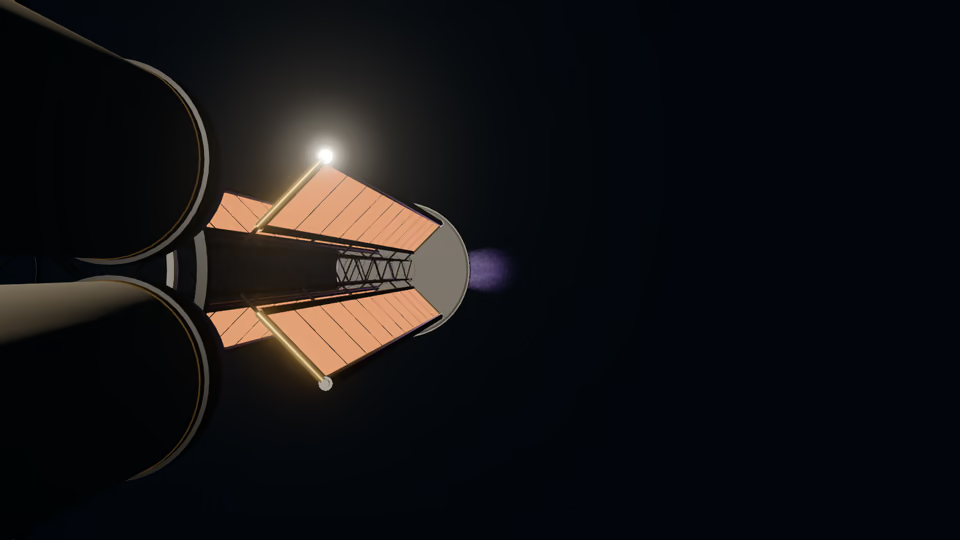
A shield does not wrap the ship. It only has to stand between the core and the people. The core is 7 m in radius and 40 m long. The disc is 31 m in radius and stands 54 m ahead of it design. Any point that has no straight line to any part of the core is in full shadow, and that region widens as it runs forward physics.
The shadow is 37 m from the axis where the radiators begin, 101 m at the gallery window and 146 m at the aft drum design. Every crewed part of the ship is inside it. The shield decides where the rest of the ship can go.
Mass against distance
At a given thickness, a shield's mass follows its area, and area follows the square of its radius. The radius needed to shadow a fixed target grows in proportion to the disc's distance from the core physics. At today's spacing the smallest disc that shadows the radiators, tanks, gallery and drums is 24.6 m in radius, and the radiators set that figure physics. Stand it 30 m closer and 19.0 m is enough, 60% of the area physics.
Closer is not free. The neutron flux on the disc rises as the inverse square of the distance, and the power-conversion machinery occupies the 50 m between core and shield design. Attenuation falls off exponentially with thickness, so the extra flux costs thickness only in proportion to its logarithm physics. The designer trades a smaller disc against a thicker one.
Key numbers
| Quantity | Value | Basis |
|---|---|---|
| Neutron from D + D → ³He + n | 2.45 MeV | physics |
| Neutron from D + T → ⁴He + n | 14.05 MeV | physics |
| Core | 7 m radius, 40 m long | design |
| Shield | 31 m radius, lithium hydride | design |
| Core to shield face | 54 m | design |
| Shadow radius at radiators / gallery / aft drum | 37 m / 101 m / 146 m | design |
| Smallest shadowing disc, today's spacing | 24.6 m radius | physics |
| Same, 30 m closer to the core | 19.0 m radius | physics |
| Hot waste, share of fusion power | 20% | challenge |
Sources
- Kaszubinski 1973, Shield materials recommended for space power nuclear reactors (NASA Lewis, NTRS 19730018853)
- Wang et al. 2021, The AME 2020 atomic mass evaluation (II), Chinese Physics C 45, 030003
- Razin et al. 2014, A direct fusion drive for rocket propulsion, Acta Astronautica 105