Home / Nuclear / Energy per kilogram
Energy per kilogram
A kilogram of fusion fuel holds 35 million times the energy of a kilogram of methane and oxygen, and that gap is the whole reason the crossing is possible.
See it in the tour: chapter long passage, shot 0.8.
One scale
Every fuel on the page is measured the same way: the energy it releases per kilogram of the stuff that reacts, oxidiser included. Chemistry rearranges electrons, and a methane and oxygen mix gives 1.0 × 10⁷ J/kg. Fission rearranges the pieces of a heavy nucleus, and complete fission of uranium-235 gives 8.2 × 10¹³ J/kg. Fusion of deuterium with helium-3 gives 3.5 × 10¹⁴ J/kg physics. The gaps are about 8 million and 35 million times physics.
E = mc² as a budget line
The most a kilogram can ever give is all of its mass, 9.0 × 10¹⁶ J, since c² is that number physics. Each fuel spends a fraction of that budget.
| Fuel | Mass turned into energy |
|---|---|
| Methane and oxygen | 0.000000011% |
| Uranium-235 fission | 0.091% |
| Deuterium and tritium | 0.38% |
| Deuterium and helium-3 | 0.39% |
The chemical figure is one part in nine billion. The fusion figure is the 0.019703 u worked through on Inside the fusion drive physics. No fuel in this table spends even half a percent. The rest of the mass is still there afterwards, as the products.
What a crossing costs
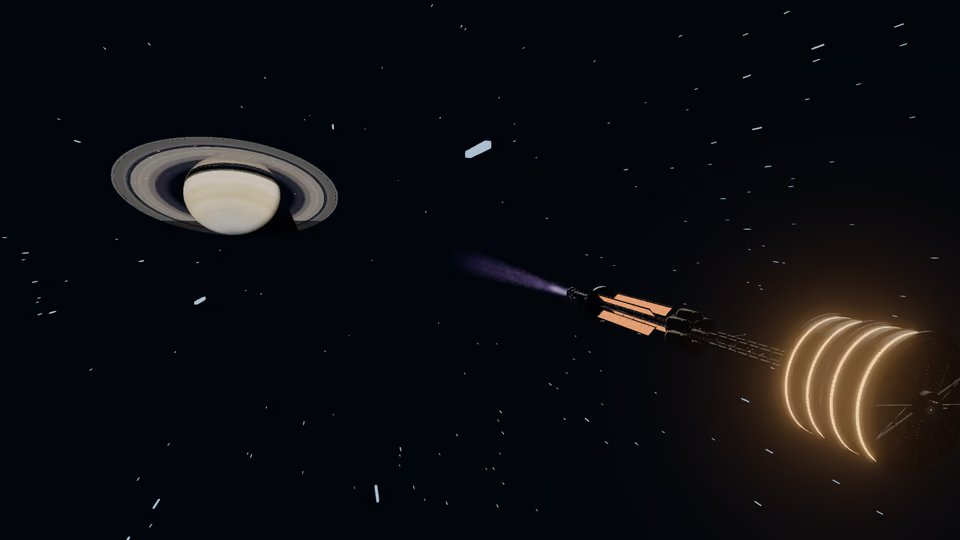
The Long Passage makes 10.6 GW for 142.9 days, 1.3 × 10¹⁷ J challenge. Fuelled by methane and oxygen that would take about 13 million tonnes of propellant. Fuelled by fission it would take about 1,600 kg of uranium-235 fissioned completely physics. On deuterium and helium-3 it takes 371 kg challenge. The 3,935-tonne hydrogen load is reaction mass, not energy. See Fusion propulsion and helium-3.
Energy sets a speed ceiling
If every joule of a fuel went into the speed of its own exhaust, the exhaust speed would be √(2E) physics. For methane and oxygen that is 4.5 km/s. The Kraken Shore ascent vehicle reaches 3.4 km/s design, the same range. For deuterium and helium-3 the ceiling is 26,500 km/s, 9% of the speed of light physics.
The ship does not use it. At that speed thrust would be tiny, so she feeds hydrogen into the exhaust and settles at 200 km/s challenge. Fuel energy sets how fast a rocket could go. Reaction mass sets how hard it can push on the way.
Key numbers
| Quantity | Value | Basis |
|---|---|---|
| Methane and oxygen | 1.0 × 10⁷ J/kg | physics |
| Hydrogen and oxygen | 1.3 × 10⁷ J/kg | physics |
| Uranium-235 fission | 8.2 × 10¹³ J/kg | physics |
| D + T fusion | 3.4 × 10¹⁴ J/kg | physics |
| D + ³He fusion | 3.5 × 10¹⁴ J/kg | physics |
| Energy in 1 kg of mass, mc² | 9.0 × 10¹⁶ J | physics |
| Mass converted, D + ³He | 0.39% | physics |
| One crossing | 1.3 × 10¹⁷ J | challenge |
| Energy-limited exhaust speed, methane and oxygen / D + ³He | 4.5 km/s / 26,500 km/s | physics |
Sources
- NIST, CODATA fundamental physical constants (speed of light, atomic mass unit)
- NIST Chemistry WebBook, methane and water (enthalpies of formation)
- Wang et al. 2021, The AME 2020 atomic mass evaluation (II), Chinese Physics C 45, 030003